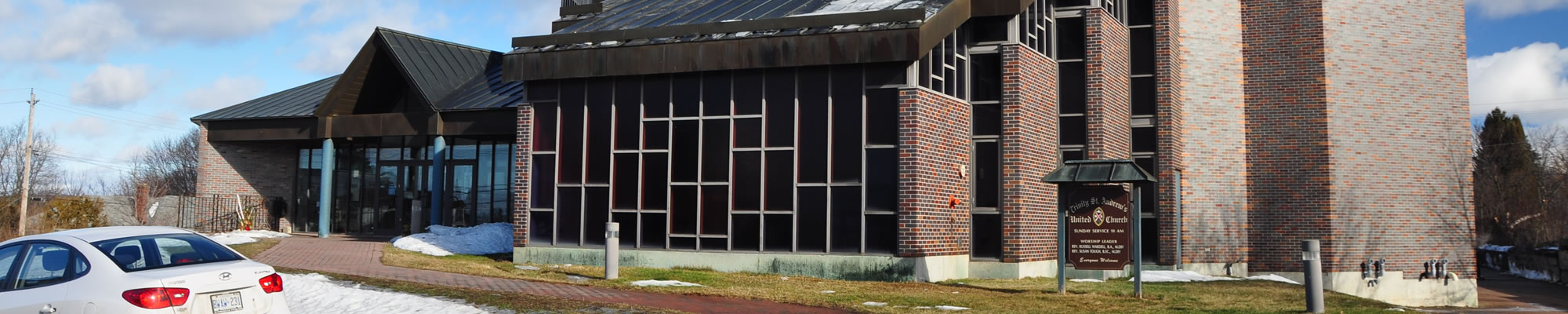
Trinity-St. Andrew’s United Church
Order of Worship
Sunday, July 12, 2026 – 7th after Pentecost
We welcome Danah-Lee Krieger as our guest speaker today.
We welcome Schroeder Nordholt as our guest Music Director today.
Prelude
Words of Welcome / Land Acknowledgement
Announcements
Lighting the Christ Candle
Passing the Peace of Christ
Call to Worship
Leader: We come to worship with whatever is on our hearts.
All: Our cries for help, our words of thanks and our moments of wow.
Leader: We come knowing that prayer doesn’t have to be perfect.
All: God meets us exactly where we are.
Leader: Come, Let us worship God.
All: Amen.
Hymn This Is the Day/God, I Lift Your Name on High (medley)
This is the day, this is the day
That our God has made, that our God has made
We will rejoice, we will rejoice
And be glad in it, and be glad in it
This is the day that our God has made
We will rejoice and be glad in it
This is the day, this is the day
That our God has made
God, I lift Your name on high
God, I love to sing Your praises
I’m so glad You’re in my life
I’m so glad You came to save us
You came from heaven to earth to show the way
From the earth to the cross, my debt to pay
From the cross to the grave, from the grave to the sky
God, I lift Your name on high
God, I lift Your name on high
God, I love to sing Your praises
I’m so glad You’re in my life
I’m so glad You came to save us
You came from heaven to earth to show the way
From the earth to the cross, my debt to pay
From the cross to the grave, from the grave to the sky
God, I lift Your name on high
You came from heaven to earth to show the way
From the earth to the cross, my debt to pay
From the cross to the grave, from the grave to the sky
God, I lift Your name on high
This is the day, this is the day
That our God has made
This is the day, this is the day
That our God has made
Prayer of Approach
Scripture Reader: Sandra Comba
Genesis 18:17-33
Genesis 21:14-19
Matthew 6:5-15
Hymn Open Our Eyes
Open our eyes, God
We want to see Jesus
To reach out and touch Him
And say that we love Him
Open our ears, God
And help us to listen
Open our eyes, God
We want to see Jesus (2x)
Sermon Help, Thanks, Wow!
The Lord’s Prayer, VU 959
Special Music: Mike Gorman
The Offering
Offering Song God is So Good
God is so good. God is so good. God is so good. He’s so good to me.
God answers prayer. God answers prayer. God answers prayer. He’s so good to me.
Offering Prayer
Hymn As the Deer
As the deer panteth for the water
So my soul longs after You
You alone are my heart’s desire
And I long to worship You
You alone are my strength, my shield
To you alone may my spirit yield
You alone are my heart’s desire
And I long to worship You
You’re my friend and you are my brother
Even though you are a king
And I love you more than any other
So much more than anything (Chorus)
Pastoral Prayer
Hymn Leaning On the Everlasting Arms
What a fellowship, what a joy divine
Leaning on the everlasting arms
What a blessedness, what a peace is mine
Leaning on the everlasting arms
Refrain:
Leaning, leaning
Safe and secure from all alarms
Leaning, leaning
Leaning on the everlasting arms
O how sweet to walk in this pilgrim way
Leaning on the everlasting arms
O how bright the path grows from day to day
Leaning on the everlasting arms Refrain
What have I to dread, what have I to fear
Leaning on the everlasting arms
I have blessed peace with my Lord so near
Leaning on the everlasting arms Refrain
Benediction
Choral Amen Amen, amen, amen VU 967
Help, Thanks, Wow!
Danah-Lee Krieger, July 12, 2026
I want to start by telling you something that might give you a little chuckle this morning. I heard about this minister who was driving down the road when he got pulled over by a police officer. The officer came to the window, caught a whiff of alcohol, and noticed a thermos and so he said to the minister, “Sir, what are you drinking?” The minister replied, “Just water, officer,”. The officer asked to see the thermos, and he took a sniff, and said, “This smells like wine to me!” The minister said, “Well… what do ya know?! Jesus did it again!”
Before we get started, let’s do a little poll. How many of you attended Sunday school as kids? Raise your hands. Okay, now how many of you ever went to Vacation Bible School, VBS? Raise your hands.
For those of you who sadly missed out, Vacation Bible School was a summertime staple in a lot of churches. It was usually a week or 2. It included Bible stories, crafts, songs, games and of course juice and cookies.
But if you never been to VBS, as a kid, now is your chance. Because while Eric is away over the course of 4 different Sundays this summer, I’ll be offering a little mini-series of my own. For our 1st week of VBS for Adults, the sermon title is Help, Thanks, Wow. And here’s the disclaimer, the title isn’t an original. It’s taken from the title of Anne Lamott’s book Help, Thanks, Wow, (which I will be reading a few excerpts from today).
But let’s do a little challenge here… I want you to finish these sentences…
“Our Father who art in heaven”
“God, grant me the serenity”
“Lord, make me a channel of your peace”.
And with these in mind, if you still haven’t figured out what our 1st VBS topic will be, let me help you. This morning we’re going to be talking about Prayer. And I am hopeful that this morning’s message will give you another new perspective from last week’s message and will give you something to mull over this week.
Before we go any further on prayer this morning, let’s get some practice, shall we? Would you bow your heads and pray with me?
Loving God,
May the words of my mouth, the meditations of our hearts and indeed the actions of our lives always be acceptable to you, our Rock and our Redeemer. In Jesus’ Name, Amen.
My understanding of prayer has changed a lot since attending VBS in the Baptist Church. Growing up at First Baptist Church, there was a very particular, unspoken formula for praying correctly. Ideally, you were an older white man. You stood with your arms folded in exactly the right way, began with “Dear Heavenly Father,” and adopted an unusually shaky “prayer voice” that appeared only when someone bowed their head.
We insisted our prayers were natural and off the cuff. Written prayers were considered far too insincere, or, dare I say, liturgical. And yet everyone seemed to use the exact jargon and tone of voice. In hindsight, it all seems remarkably rehearsed.
But one of my first memories of prayer as a child didn’t come from the Baptist church, it comes from a camping trip with my grandparents at Cedar Lake in Algonquin Park. I remember lying in my grandparents’ little trailer and learning my first prayer, one I’m sure many of you learned too. Apparently, this little gem made the Top 40 of childhood prayers… “Now I lay me down to sleep, I pray the Lord my soul to keep. If I die before I wake, I pray the Lord my soul to take.” Which, when you think about it, is a rather terrifying prayer to teach a child just before bedtime. But after I would recite this prayer, my grandma taught me to add my own prayers after and put a personal spin on things. So, then I would say “I pray for my mom. I pray for my dad. I pray for my brother…” and I would just keep going from my immediate family and then outwards. Most nights, I would fall asleep somewhere around praying for my cousins. But this was a routine that my grandma instilled within me. I wasn’t thinking about theology or whether I was praying correctly. I was simply naming the people I loved and there was something beautifully uncomplicated about that childhood understanding of prayer. I spoke and trusted that God listened.
My hope today is to demystify prayer a little bit. But even after preparing this message, I’m still left swirling in its mystery. In her book, Anne Lamott suggests that there are 3 essential prayers: help, thanks and wow. So, this morning, I thought we could walk through each of them together.
But there are a few caveats before diving into to the crux of today’s message. Firstly, the beauty of help, thanks and wow is that there’s no particular order of how or when you should pray these prayers. It ultimately depends on what’s happening in your own personal life and journey. At some point in each of our lives, we will encounter a help, thanks or wow time. But for the sake of the title, I’ll walk through them in that order.
Secondly, there’s a misconception that only especially “holy” people pray well, or that prayer requires elevated or elitist type language. If you’ve ever believed that I encourage you to let it go. Apart from Christ, nearly everyone in scripture prays from a place of need, desire or desperation. Prayer isn’t one-size-fits-all. Each of us must discover what it looks like in our own lives. Can I get an amen?
So, what is prayer exactly?? Well… I almost feel guilty trying to pigeonhole “prayer”, but at its core, prayer is simply an honest conversation from our hearts to God’s heart. And if that still feels out of reach, remember that prayer doesn’t always require words. Sometimes we simply don’t know what to say. In Romans, Paul reminds us that in those moments, God’s Spirit speaks for us when we can’t find the words ourselves.
Which brings us to our first word in the title, “Help”.
Also, in those moments when we have no words, or when we’ve reached our own personal rock bottom, or when we’re praying on behalf of someone else, a simple cry of “HELP” or FOR “HELP” is enough. A prayer like, “Oh God, help me now,” can hold out in almost any crisis.
Anne Lamott puts it like this: “Dear Some Something, I don’t know what I’m doing. I can’t see where I’m going. I’m getting more lost, more afraid, more clenched. Help.”
Help can really make the world of difference. It’s the letting go and knowing that we can’t do it all.
How many of you here are good at worrying? When something pops into your mind, you immediately start overthinking and plotting out every worst-case scenario. Can I see a show of hands? How many of you are you good at anxiety? Raise them up.
How about anger fantasies? You know exactly what I mean, those imaginary arguments you have with someone in your head while you’re driving or when you’re in the shower. Let me ask you, how many of you have ever lost an argument during an anger fantasy? It doesn’t happen, does it? In our anger fantasies, we win every single time!
So, let me suggest something to you. If you’re good at any of those things, you’re good at prayer. Here’s the difference… with anger fantasies, worry or anxiety, we’re actually talking to ourselves. But… the concept is really just the same because you’re having a dialogue. You’re detailed and centered. All I would love for us to consider today is shifting who we’re talking to in those moments. We’re already wired for these internal types of conversations. That’s why we have them, perhaps, if we could just interrupt the pattern of the cyclical self talk and direct it to God. That’s why Paul says, “Don’t worry, pray.” He’s just making a shift in who we’re speaking to.
But often, we over-complicate prayer and think of it as a transaction. We treat it like a laundry list meant to persuade an external God to step in and solve our problems. But true prayer doesn’t require us to bargain with or manipulate God. Prayers for healing can have a real impact. It’s simply knowing that we don’t have the control. As humans, we crave comfort and control. But control is an illusion. And that’s a sermon for another day. But if you struggle with any part of prayer, let me give you a clear first step. Understand this… Prayer isn’t about changing God’s mind. It’s about God changing our minds. Now you might bring your mind back to this morning’s reading from Genesis that think, “That’s not true. We have this example from Genesis where Abraham changed God’s mind about Sodom and Gomorrah.” I would challenge that.
Remember the story: God tells Abraham that the cities are so sinful and that God is going to wipe them out. Everyone else walks away and says, “Sounds good, God.” But Abraham stays behind. He steps up and asks, “God, what if you find 50 righteous people?” God says, “If I find 50, I’ll spare it.” Right there, Abraham is praying. He’s having this dialogue with God.
Then the bartering begins. “What if you find 45?” God says, “I’ll spare it.” Abraham talks God all the way down until his final request: “may you not become angry at my last request God…. what if you find just 10?” And God says, “For the sake of 10, I will not destroy it.”
Did Abraham successfully change God’s mind? No. God already knew there weren’t 10.
So, what actually happened? We see a massive shift in Abraham. Through this prayer process, Abraham is forced to fight with deep empathy for the innocent. He is experiencing the true character of the Divine. God was teaching him, “I am a God of justice, not simply a God of cold judgment.”
Abraham didn’t convince God that a human knew better. It was an example of God showing Abraham: “You need to be a leader of empathy and mercy. But understanding that even thought I am just, I am also deeply merciful.” We know how the story ends. There were only 3 righteous people who escaped: Lot and his 2 daughters. Not even 10. We don’t change God’s mind in prayer. God changes ours.
Which brings me to our next word: “Thanks.”
The 14th-century German mystic Meister Eckhart famously said, “If the only prayer you ever pray is ‘thank you,’ it will be enough.” Believe it or not, “Thanks” was the hardest part of this message for me to write. That seems strange, because everywhere we turn, there are books and self-help gurus talking about gratitude and living with an abundant mindset. You might think this would be the easiest prayer to talk about. But gratitude isn’t as simple as it sounds. It’s complex and deeply personal. There are different levels of thankfulness, and one doesn’t diminish the importance of another.
I’ll give you an example. Last week, my microwave blew up. I was reheating something, and when the cycle finished, it beeped like everything was perfectly normal. I opened the door to take out my culinary masterpiece… and the microwave just kept on truckin’. The door was open. The timer was done. But apparently the microwave had decided it was no longer bound by rules. Then it started making some very bad noises, and I could smell what seemed like burning wires. So, I immediately unplugged it.
It’s one of those over-the-range microwaves with the built-in exhaust fan, and it came with the house when I bought it. I was very grateful that I was standing right there when it happened and wasn’t away in Toronto while my microwave was at home trying to launch into space. And it was either Carmen or ChatGPT… I can’t remember which… sorry Hunny that said to me, “Open the door. There should be a date and some information about the inside.” Well…the microwave was made in 1997.
So, yeah. I wasn’t getting spare parts. That microwave had lived a full life. I wasn’t exactly excited or grateful about dropping $600 on a new one. But I was thankful I was home; I caught it when I did and my house didn’t burn down. And that’s important… but it’s contextual. That’s a very different kind of gratitude prayer from the prayer that our family prayed when my dad regained his ability to walk after every neurologist told him he would likely be wheelchair-bound following traumatic experience with transverse myelitis in the mid-2000s. Fast forward 20 years later… does he still walk with a bit of a limp from time to time? Yes. But is he walking? YES! Praise God. It’s also a very different kind of gratitude prayer than I felt when every pipe in my home burst when I bought my home and my dad was able to fix it for me without me calling a plumber. All of these moments stir gratitude, but they don’t live on the same playing field to one another. Gratitude is complex. It’s deeply personal, and it runs through different layers of our lives.
Paul writes in 1st Thessalonians, “Give thanks in all circumstances.” Notice that he does not say to give thanks for all circumstances. He says IN all circumstances.
That distinction matters, because bad things happen to good people all the time. Life has a way of being much harder than we would like it to be. Gratitude doesn’t require us to pretend that everything is fine.
It’s easy to thank God when life is going well. It’s easy to recognize God when you’re sitting in the backyard with people you love or lying on the couch cuddling your grandchild or pet. It becomes much harder when the doctor calls and asks you to come in talk about the test or scan results, or when a relationship ends or your life is in shambles. Yet, Paul says even in those circumstances, there may is still room for thanks. Anne Lamott writes, “Most of the time, gratitude is a rush of relief that I dodged a bullet. ‘Oh my God, thankyouthankyouthankyou.’ These are moments of relief and gratitude worth giving God thanks. “‘Thanks’ can be the recognition that you’ve been blessed mildly, or with a feeling as intense as despair at the miracle of having been spared.
“You say, ‘Thankyouthankyouthankyouthankyou. My wife is going to live. We get to stay in this house. They found my son: he’s in jail, but he’s alive; we know where he is, and he’s safe for the night.’
“Things could’ve gone either way, but they came down on our side. It could’ve been much, much worse, and it wasn’t.” That really stayed with me. Gratitude doesn’t always arrive as joy. Sometimes it comes as relief. We shouldn’t live in fear of how much worse life could become, but because even when life doesn’t turn out the way we hoped, we may eventually recognize that we were given something we needed.
I used to pray so many prayers about how I wanted situations or relationships to turn out. Now one of my favourite prayers is, “Thank you, God, for giving me what I needed instead of what I thought I wanted.” Prayer is not about changing God’s mind. Prayer opens us to the possibility that God may change our minds.
And lastly, the moment you have all been waiting for… “Wow!”
Sometimes “wow” is closely tied to thankfulness, but sometimes it’s a little less obvious. We all know the “help” prayer. We know exactly what it feels like to cry out to heaven, and many of us can relate to that. Most of us are also familiar with the idea of gratitude and saying “thanks.” Those prayers are easy to recognize. But the “wow” prayer can be one of those things that is around us, all the time. Sometimes it happens when we suddenly become awake to something that was already there. And there are different levels of “wow.” Or if we experience something exhalating for the first time. Or it can even be something shocking we experience. It could be, “Wow, I woke up this morning and my pain was gone.” Or “Wow, I woke up beside the most beautiful person.” It could be, “Wow, you need to pop a breath mint” Or frankly, “Wow, the flooding was destructive” or “wow” … if you’ve ever been to the ocean or a new part of the world for the first time. In her book, Anne speaks about the experience of 9/11 and how that is a “wow” prayer because of it’s extreme overwhelm and how many of us who were around out that time, were paralyzed in the disbelief.
And sometimes “wow” is like the story of Hagar. She desperately needed water, and the well had been right in front of her the whole time. God opened her eyes and helped her see what she couldn’t see before. Sometimes the “wow” is just taking things from a different vantage point. Literal or figurative. She went from a plea of “Oh God, help me now”, the great reveal of something that was there literally the entire time.
Maybe the “wow” isn’t only recognizing what God has placed in front of us. Maybe the ultimate “wow” is realizing that God can work through us and that we might be the answer to someone else’s prayer, or even our own. We might pray, “God, help the hungry,” while there’s food in our own cupboard that we could share. We might pray for someone who’s lonely, when we could easily pick up the phone.
Anne says, “Wows come in all shapes and sizes, just like people. There are the lowercase wows. These are the times when we sink into something modest, only to find that it delivers above and beyond”. And if there are days when we can’t even manage to mutter, “Help,” “Thanks,” or “Wow,” Jesus has already given us the words to sum in all up. When the disciples asked Jesus how to pray, he didn’t give them a complicated formula or tell them they needed impressive language. He essentially gave them a prayer manual.
“Our Father, who art in heaven, hallowed be thy name.”
That’s wow. It begins in wonder, recognizing the holiness and mystery of God.
“Give us this day our daily bread.”
That’s help. Give us what we need for today, not everything for the next 10 years, just enough grace and strength to get through today.
“Forgive us our trespasses, as we forgive those who trespass against us.” That’s help too. Help us receive mercy and help us become more merciful.
“Thy kingdom come; thy will be done.”
That’s surrender. It’s letting go of our need to control everything and trusting that God may be doing something larger than we can see. And underneath the whole prayer is thanks. This gratitude that we are heard and cared for… and that we are given daily bread, forgiveness and the promise that we don’t face temptation or suffering alone.
So, when we don’t know what to say, we can return to the words that Jesus taught to pray. I thought instead of saying it this morning, that we could sing this together. In Voices United 959.
“Our Father, who art in heaven, hallowed be thy name.
Thy kingdom come; thy will be done on earth as it is in heaven.
Give us this day our daily bread, and forgive us our trespasses,
As we forgive those who trespass against us.
Lead us not into temptation but deliver us from evil.
For thine is the kingdom, and the power, and the glory, for ever.
Help. Thanks. Wow.
Amen.